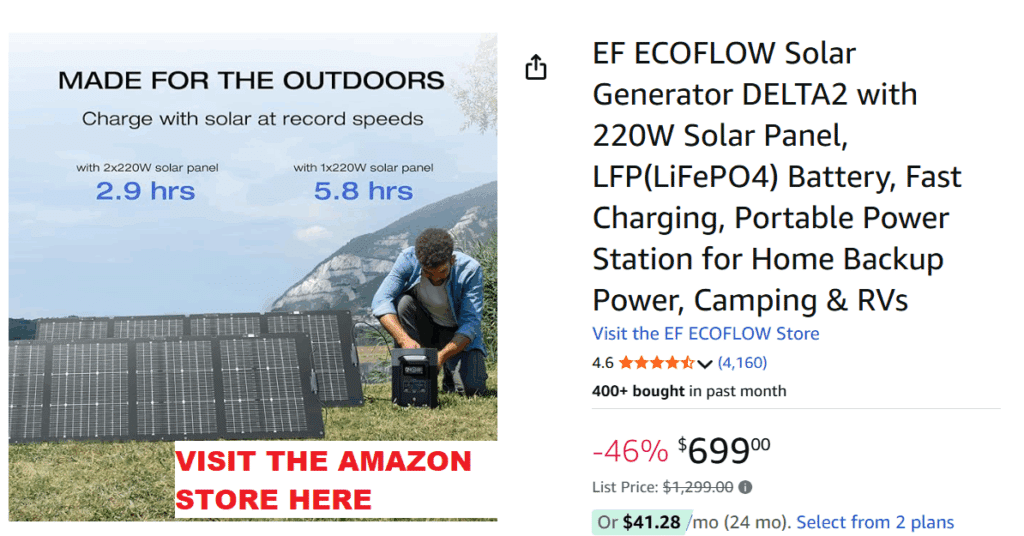
The EF ECOFLOW Solar Generator DELTA2 with 220W Solar Panel, LFP(LiFePO4) Battery, Fast Charging, Portable Power Station for Home Backup Power, Camping & RVs gives you clean, quiet, and expandable power for camping, RV trips, or keeping your home running during outages. With fast solar charging, an LFP battery rated for 3000+ cycles, and up to 1800W output, you’ll have reliable, long-lasting energy wherever you go.

EF ECOFLOW Solar Generator DELTA2 with 220W Solar Panel, LFP(LiFePO4) Battery, Fast Charging, Portable Power Station for Home Backup Power, Camping & RVs
You’re looking at a portable power solution that’s designed to be green, quiet, and rugged enough to follow you from the backyard to the backcountry. The EF ECOFLOW Solar Generator DELTA2 with 220W Solar Panel combines an LFP (LiFePO4) battery, fast charging capabilities, a 220W bifacial solar panel, and plenty of output ports into a single ecosystem built for home backup, camping, and RV living.
In this article, you’ll get a friendly, thorough rundown of what the DELTA 2 does, how it performs, and whether it’s a good fit for your needs.
Why a solar generator might be right for you
If you want reliable power without the fumes, noise, and maintenance of a gas generator, a solar generator is a smart alternative. You’ll appreciate the silent operation, instant-on capability, and the ability to charge from the sun while you’re off-grid. The DELTA 2 is positioned as a clean, green charging solution that gives you both AC-level output and the flexibility to recharge through solar panels, making it appealing whether you’re planning weekend adventures or preparing for outages at home.
Key features of the DELTA 2 you should know
The DELTA 2 combines hardware and design choices that prioritize longevity and versatility. It supports up to 500W of solar input, includes a 220W bifacial solar panel, uses a LiFePO4 battery chemistry with a very long cycle life, and delivers 1800W continuous output through multiple outlets. You’ll also find it user-friendly with included charging and solar cables, an adjustable kickstand case for deploying the panel, and a configuration that makes expansion straightforward if you want more storage later.
- Clean solar charging via the 220W bifacial panel (captures reflected light)
- Up to 500W solar input for faster solar recharge when you add panels
- LFP (LiFePO4) battery chemistry for 3000+ cycles
- 1800W output through 15 outlets to support a wide range of devices
What LiFePO4 (LFP) battery chemistry means for you
When you see LFP or LiFePO4, you should think longevity and safety. The DELTA 2’s LFP battery boasts more than 3000 cycles, which the product describes as “6x longer” than some typical chemistries used in portable power stations. For you, that translates into years of repeated charge/discharge use before capacity significantly declines. LFP cells are also more thermally stable and less prone to combustion under stress than some other lithium chemistries, which adds a layer of safety for in-home backup and extended outdoor use.
The 220W bifacial solar panel and solar input are explained.
Solar is at the heart of what makes a solar generator special, and the DELTA 2 ships with a 220W bifacial solar panel. Bifacial panels can capture not only direct sunlight on the front but also reflected light from the ground, increasing potential yield—ECOFLOW advertises up to 25% more energy capture under ideal conditions.
The DELTA 2 supports up to 500W of solar input, so while a single 220W panel can keep you topped up, adding a second or third panel can significantly accelerate charging when conditions are good. For camping or RV use, that means you can recharge during daylight hours and draw power at night.
Fast charging — what to expect
Fast charging is one of the headline conveniences of this system. DELTA 2 supports rapid recharging methods to get you back to full capacity more quickly than legacy power banks. You can plug into AC power for fast wall charging and supplement or replace wall charging with solar when you’re off-grid. The unit’s ability to accept a higher solar input (up to 500W) means you have a practical way to speed up charging using more than one solar panel. That flexibility gives you options: charge from the grid at home before you leave, then top up with solar while you’re away.
How much power does a 1800W output actually give you?
An 1800W continuous output is substantial for a portable power station. It means the DELTA 2 can drive many household appliances and tools that smaller power stations can’t handle. You’ll be able to start and run devices with short surges—like refrigerators, power tools, or CPAP machines—because the inverter is sized to handle higher loads. That said, runtime depends on the battery’s energy (1kWh standalone as described), the device’s power draw, and real-world factors like inverter efficiency and usage patterns.
Here are some illustrative examples to help you picture run times, using simple math and conservative assumptions:
- A 60W laptop: ~16 hours on a 1kWh battery (1000Wh / 60W ≈ 16.6 hours).
- Smartphone charging (10W average): ~100 hours (1000Wh / 10W = 100 hours).
- Mini fridge drawing 60–120W on average: ~8–16 hours depending on duty cycle.
- A 1500W space heater: ~0.6–0.7 hours (1000Wh / 1500W ≈ 0.67 hours) — big loads drain the battery fast.
Keep in mind these are estimates before accounting for inverter losses and battery reserve strategies. If you expand capacity to the full 3kWh, multiply run time roughly by three, giving far more practical autonomy for larger loads.
Expandable capacity: scale from 1–3kWh
One of the DELTA 2’s significant advantages is expandability. The standalone unit offers around 1kWh of storage, and you can add extra batteries to reach up to 3kWh. For you, that means you can start with a compact unit for portability and then scale up as your needs grow—ideal if you later want more resilience for home backup or longer off-grid trips. Expansion multiplies your runtime and reduces the frequency of recharging, turning the DELTA 2 into a more serious energy hub when needed.
Ports and outlets: power more devices at once
DELTA 2 provides 15 outlets, so you’re not just limited to a couple of USB ports and one AC socket. The mix of AC, DC, USB-A, and USB-C outlets (and possibly fast-charging ports) enables you to run laptops, cameras, lights, small kitchen appliances, medical equipment like CPAP machines, and phone chargers simultaneously. That output variety is what makes this valuable unit across home, RV, and camping scenarios: you can configure a little power setup for multiple people without juggling cords or adapters.
Portability, build quality, and what’s in the box.
The DELTA 2 is designed to be portable while still delivering significant power. ECOFLOW includes an adjustable kickstand case for the panel to help you find the correct tilt for sunlight, plus the DELTA 2 power station and necessary cables: an AC charging cable and a solar charging cable. Note that DELTA 2 and the 220W Portable Solar Panel may arrive separately, which is worth knowing so you’re prepared when shipments show up.
The product features durable construction and an accessory set designed to help you get dashing.
Safety and the built-in Battery Management System (BMS)
You’ll appreciate that DELTA 2 includes a sophisticated Battery Management System (BMS) to oversee charge, discharge, cell balancing, and thermal conditions. The BMS protects the battery by auto-regulating charging rates, preventing overcharge and deep discharge, and managing temperature—key protections that maintain battery health and safety.
These features are essential for home backup, where the unit may remain connected for extended periods, and for outdoor use, where environmental conditions are constantly fluctuating.
Real-world use cases: camping, RVs, and home backup
DELTA 2 is designed to be flexible across several common scenarios. When you’re camping, the solar panel means you can charge during the day and run lights, phones, and small appliances at night—no noisy generator required. In an RV, you’ll find it helpful in topping off batteries, powering electronics while boondocking, or supplying power at campsites without shore power.
For home backup, the DELTA 2 can handle critical loads during outages—lights, communication devices, small refrigerators, and medical equipment—especially if you expand your battery capacity. Its quiet operation and lack of fumes make it suitable for indoor or semi-enclosed situations that would be problematic for gas generators.
Tips to maximize runtime and efficiency
To get the most from your DELTA 2, a few simple habits will extend run times and life:
- Prioritize essential loads: identify what truly needs power during an outage and power those first.
- Use energy-efficient devices: LED lighting, energy-efficient fridges, and lower-draw electronics extend run time.
- Leverage solar during daylight: position the bifacial panel well, clean it regularly, and add more panels if you can.
- Avoid unnecessary surges: defer high-draw appliances unless you’re prepared for rapid battery depletion.
- Store and operate within recommended temperatures: LFP cells like moderate climates; avoid extreme heat or cold when possible.
These small steps help turn the DELTA 2 into a more reliable and long-lasting companion for your adventures and emergencies.
Charging strategy with the 220W panel and additional panels
A single 220W panel will provide a meaningful solar charge during sunny conditions, and its bifacial design may increase yield depending on ground reflection and orientation. If you want faster solar charging, you’ll benefit from adding panels to approach the DELTA 2’s 500W solar input limit.
In practice, that means pairing the included panel with one or more additional panels (or higher-watt panels that are compatible) to shorten the solar charge time.
When you’re at home and have grid access, use AC to top off quickly before heading out; when you rely on sunlight, place panels for maximum direct sun and consider reflective surfaces that can help bifacial panels capture more energy.
Maintenance and storage: simple steps to prolong life
Your DELTA 2 will serve you best with a bit of basic care. Keep the unit and panels clean from dirt and debris, check for cable wear, and store the system in a cool, dry place when not in use. If you’re putting the unit into long-term storage, charge it to a moderate level before storing and check periodically—LiFePO4 prefers being kept within a healthy range rather than fully discharged for extended periods.
Following the manufacturer’s guidance on storage temperature and periodic checks will help you avoid surprises when you need power.
Troubleshooting common issues
You might encounter a few small challenges over time, like slow solar charging on cloudy days, unexpected shutdowns when pushing high loads, or connection issues with external panels. Most of these symptoms point to predictable causes: insufficient sunlight, drawing more power than the battery capacity supports, or loose connections. Examine cabling, verify panel orientation, check the output load against the inverter capacity, and consult the user manual if errors appear. The BMS offers protective shutoffs that might trigger under stress—if that happens, reduce the load, let the system cool, and try again.
Frequently asked questions
What happens if I run out of battery while camping? If your battery drains, you’ll need to recharge via AC (if available), solar, or a vehicle connection. Redundancy plan—either additional panels or an external charging option—if you’ll be off-grid for long stretches.
Can you run a refrigerator or CPAP? Yes, the DELTA 2 is designed to handle appliances like refrigerators and CPAP machines, especially given the 1800W output. Keep in mind that refrigerators have compressor start surges, but the inverter should manage typical inrush currents. Confirm your appliance’s startup/turbo wattage vs. the generator’s surge capacity if you’re relying on it for critical medical devices.
How long will the battery last? The LFP chemistry offers 3000+ cycles, which in practical terms means many years of regular use—far more cycles than many alternative chemistries. Your actual calendar life will depend on the depth of discharge, charging habits, and environmental conditions.
Do I need to purchase additional panels to utilize them effectively? The included 220W panel is enough for modest solar charging, but if you want faster recharging or intend to run heavier loads while relying solely on solar, adding more panels (up to the 500W input limit) will help.
How the DELTA 2 compares to gas generators and other power stations
Compared with gas generators, the DELTA 2 is quiet, emission-free, and requires almost no day-to-day maintenance. You won’t get unlimited run time without fuel, but you will get clean power and the ability to recharge from sunlight when conditions permit. Against other portable power stations, DELTA 2’s advantages are its LFP battery life, up to 500W solar input, and expandability to 3kWh.
When choosing between options, consider balance portability, capacity, output power, and whether you want the solar ecosystem already included.
Who should consider buying the DELTA 2?
You should consider the DELTA 2 if you:
- Want a quiet, emission-free backup power solution for outages.
- Camp or RV frequently and value the ability to charge from the sun.
- Need a portable station that can run most household devices and small appliances.
- Prefer long battery life and a safe chemistry, such as LFP, to reduce long-term replacement costs.
- Value expandability so you can increase capacity later without needing to replace the entire unit.
If you’re looking for the lightest possible power bank for single-device charging, or you want indefinite runtime without any solar or fuel, a larger fixed generator or grid-tied solution may be more appropriate.
Is the DELTA 2 the right fit for your lifestyle?
The EF ECOFLOW Solar Generator DELTA2 with 220W Solar Panel is a compelling middle ground between portability and power. It gives you substantial output (1800W), a long-lasting LFP battery, and the ability to take advantage of solar with a bifacial 220W panel, while also offering expansion to multi-kilowatt-hours if your needs grow. Whether you’re aiming to stay comfortable on an extended camping trip, keep essential devices alive during a power outage, or outfit an RV for off-grid living, the DELTA 2 is designed to make reliable, quiet, and green power accessible.
If you value flexibility—charging from both wall and sun, expanding capacity as required, and using a safe, long-lived battery chemistry—the DELTA 2 deserves serious consideration. As always, think through your expected loads and run-time needs before buying, and plan a solar and charging strategy that matches your typical usage patterns.