
Are you searching for the perfect commercial air humidifier but feeling overwhelmed by the countless options available? Look no further! In this comprehensive guide, we will walk you through all the essential factors to consider when choosing the best commercial air humidifier for your specific needs. From understanding the importance of humidity control in commercial spaces to identifying the key features to look for in a humidifier, you’ll be equipped with the knowledge necessary to make an informed decision. Say goodbye to dry air and hello to a healthier, more comfortable environment for you and your colleagues. Let’s get started on finding the best commercial air humidifier for you!
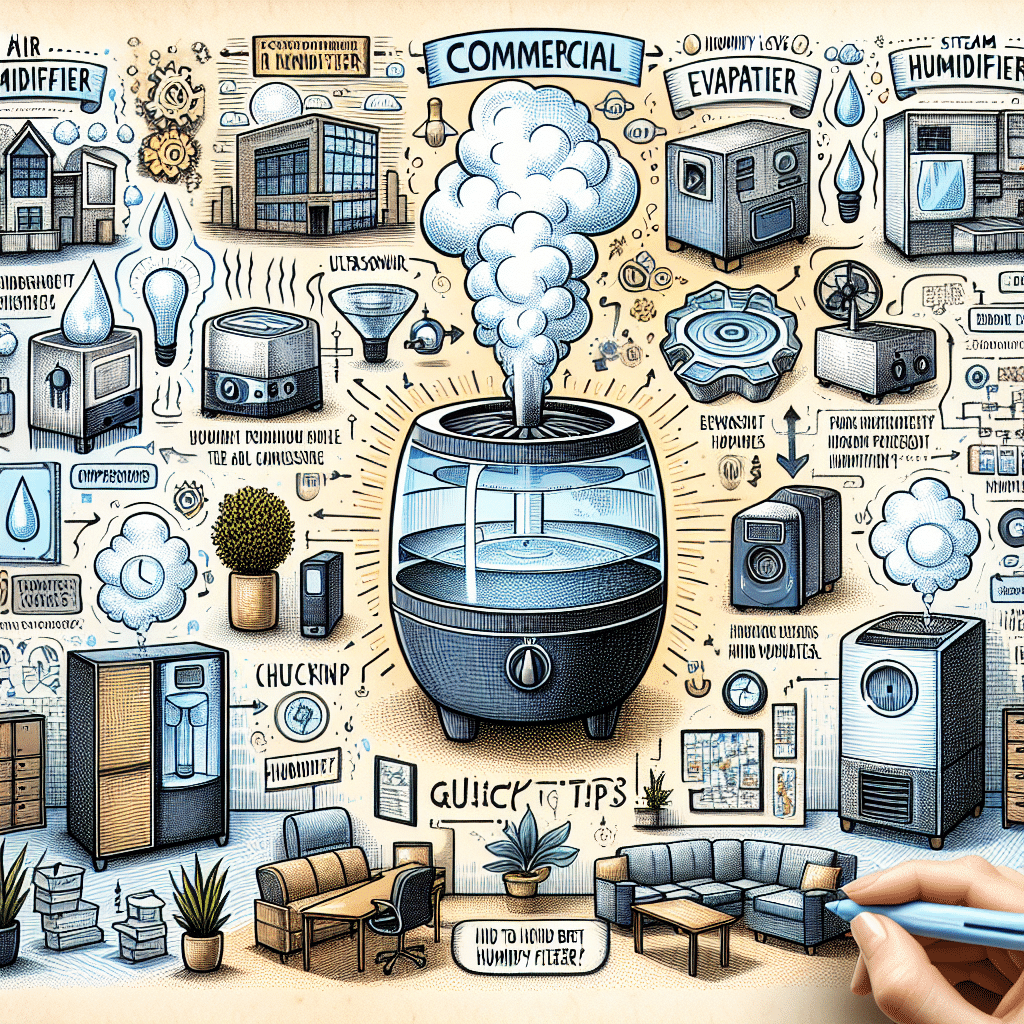
1. Understanding the Need for a Commercial Air Humidifier
Why is proper humidity important in commercial spaces?
Maintaining proper humidity levels in commercial spaces is essential for several reasons. Firstly, it helps to create a comfortable and healthy environment for those working or visiting the premises. Dry air can cause various discomforts like dry skin, irritated eyes, sore throat, and respiratory issues. By adding moisture to the air, a commercial air humidifier can alleviate these problems and improve overall well-being.
Secondly, optimal humidity levels can help protect the integrity of the building and its contents. In environments with low humidity, materials such as wood, paper, and electronics can become brittle and damaged. By maintaining appropriate humidity, a commercial air humidifier helps to prevent these costly damages, ensuring that the building and its assets last longer.
How can a commercial air humidifier help maintain optimal humidity levels?
A commercial air humidifier works by introducing moisture into the air to raise the humidity levels. It disperses water vapor evenly throughout a space, ensuring that every corner receives adequate moisture. This helps to balance the humidity, preventing it from becoming too dry or too humid.
Commercial air humidifiers come in various types, each with its own unique features and advantages. The choice of humidifier will depend on the specific needs and requirements of the commercial space. Let’s explore the different types of commercial air humidifiers available.
2. Types of Commercial Air Humidifiers
Centralized humidifiers
Centralized humidifiers are large units that are typically connected to the HVAC system of a building. These humidifiers can handle a significant amount of air and are ideal for larger commercial spaces. They distribute moisture evenly throughout the entire building, ensuring consistent humidity levels. Centralized humidifiers are often used in office buildings, hospitals, and shopping malls.
Portable humidifiers
Portable humidifiers are smaller units that can be moved around as needed. They are suitable for smaller commercial spaces or specific areas within a larger building. Portable humidifiers are versatile and often come with various features like adjustable humidity levels and timers. They are commonly used in individual offices, conference rooms, or small retail spaces.
In-duct humidifiers
In-duct humidifiers are installed directly into the HVAC system’s ductwork. They work by injecting moisture directly into the air stream, allowing for even distribution throughout the building. In-duct humidifiers are popular in large commercial spaces where maintaining consistent humidity levels is essential, such as warehouses and manufacturing facilities.
Ultrasonic humidifiers
Ultrasonic humidifiers produce moisture using ultrasonic vibrations to break water into very fine droplets. These droplets are then released into the air, increasing humidity levels. Ultrasonic humidifiers are energy-efficient and operate quietly, making them suitable for offices, classrooms, or healthcare facilities where noise can be a concern.
Steam humidifiers
Steam humidifiers generate steam by heating water and releasing it into the air. They are highly effective at increasing humidity levels and are often used in areas with very low humidity or specific environments such as laboratories or art galleries. Steam humidifiers require careful monitoring and control to prevent over-humidification.
Evaporative humidifiers
Evaporative humidifiers use a fan to blow air over a moistened wick or filter, causing water to evaporate and humidify the surrounding air. These humidifiers are energy-efficient and can cover larger areas. Evaporative humidifiers are commonly used in open-concept spaces or commercial buildings with a central air handling system.
Choosing the right type of commercial air humidifier depends on various factors, including the humidification capacity, coverage area, controls and settings, maintenance requirements, noise level, energy efficiency, installation requirements, price, and warranty. Let’s delve into each of these factors in more detail.
3. Factors to Consider Before Buying a Commercial Air Humidifier
Humidification capacity
The humidification capacity refers to the amount of moisture a humidifier can add to the air within a specific timeframe. It is important to choose a humidifier with a capacity suitable for the size of the commercial space. The humidification capacity is typically measured in gallons or liters per day.
Coverage area
Consider the square footage of the area that needs to be humidified. Each humidifier has a recommended coverage area indicated by the manufacturer. Ensure that the humidifier you choose can adequately cover the desired space to maintain optimal humidity levels throughout.
Controls and settings
Look for a commercial air humidifier with adjustable humidity levels, allowing you to tailor the humidity to your desired comfort level. Additionally, features like automatic humidistats, timer functions, fan speed control, and remote control capabilities can enhance convenience and ease of use.
Maintenance and cleaning
Regular maintenance and cleaning are crucial for optimal performance and longevity of a commercial air humidifier. Consider the frequency of filter replacement and ease of access for cleaning. Some humidifiers have removable and washable components, making maintenance simpler and more efficient.
Noise level
In a commercial setting, excessive noise can be disruptive and unwanted. Consider the decibel levels of different humidifier models and choose one that operates quietly, especially for areas where focus and concentration are required, such as offices or libraries.
Energy efficiency
An energy-efficient commercial air humidifier can help reduce operational costs and minimize environmental impact. Look for humidifiers that are Energy Star-certified or have energy-saving features. These can include automatic shut-off when desired humidity levels are reached or adjustable fan speed to conserve energy.
Installation requirements
Consider the installation requirements of the commercial air humidifier. This includes assessing the availability of a suitable water source and the quality of the water, as well as the need for drainage options. Additionally, consider electrical requirements and the availability of outlets in the desired installation location.
Price and warranty
Compare prices of different commercial air humidifiers and consider the long-term costs of maintenance, such as filter replacements and electricity usage. It is also important to review the warranty coverage and terms provided by the manufacturer to ensure peace of mind and protection against any manufacturing defects.
Brand reputation and customer reviews
Lastly, consider the reputation of the brand and read customer reviews. A reputable brand with positive reviews indicates a higher likelihood of a reliable and durable commercial air humidifier.
Determining the right humidification capacity for your commercial space is crucial to ensure optimal performance and maintain the desired humidity levels. Let’s explore how to calculate the required capacity based on square footage and other factors.
4. Determining the Required Humidification Capacity
Calculating the required capacity based on square footage
To calculate the required humidification capacity based on square footage, you need to consider the recommended humidification rate per square foot. This information is typically provided by the manufacturer for each humidifier model. Multiply the area’s square footage by the recommended humidification rate to determine the minimum capacity needed.
For example, if your commercial space is 1,000 square feet and the recommended humidification rate is 0.5 gallons per hour per square foot, you would need a minimum capacity of 500 gallons per hour.
Considering other factors like insulation, ventilation, and occupancy
Keep in mind that other factors, such as insulation, ventilation, and occupancy, can affect the required humidification capacity. Poor insulation or excessive ventilation may require a higher capacity humidifier to compensate for the additional moisture loss. Similarly, areas with high occupancy or activities that generate moisture (such as cooking or manufacturing processes) may require a higher capacity humidifier to maintain desired humidity levels.
Next, let’s assess the coverage area of a commercial air humidifier to ensure it can effectively humidify the intended space.
5. Assessing the Coverage Area of a Commercial Air Humidifier
Understanding the importance of matching the humidifier’s output to the space
Matching the output of a commercial air humidifier to the space is crucial to ensure consistent and adequate humidity levels. If the humidifier’s output is too low for the size of the area, it may result in insufficient moisture distribution. Conversely, if the output is too high, it can lead to excessive humidity, causing condensation and potential damage to surfaces and materials.
Measuring the square footage of the area to be humidified
To assess the coverage area needed, measure the square footage of the commercial space that requires humidification. This can be done by measuring the length and width of the space and multiplying those figures together. Ensure accurate measurements to determine the appropriate coverage area for the humidifier.
Matching the humidifier’s coverage area to the measured square footage is essential to maintain optimal humidity levels throughout the commercial space. Now, let’s evaluate the controls and settings of a commercial air humidifier to find one that best suits your needs.
6. Evaluating the Controls and Settings of a Commercial Air Humidifier
Adjustable humidity levels
A commercial air humidifier with adjustable humidity levels allows you to customize the humidity to your desired comfort level. This feature is particularly useful in spaces where different preferences or specific humidity requirements may exist.
Automatic humidistat
An automatic humidistat is a sensor that measures the humidity levels and automatically adjusts the humidifier’s output accordingly. This feature ensures that the humidity remains within the desired range without manual intervention, providing convenience and peace of mind.
Timer functions
Timer functions allow you to set specific time intervals for the humidifier to operate. This feature can be useful for conserving energy by automatically turning off the humidifier during periods when the space is not occupied.
Fan speed control
Choose a commercial air humidifier with fan speed control to adjust the airflow intensity. This feature allows you to customize the humidification process based on the specific needs and preferences of the space.
Remote control capabilities
Remote control capabilities add convenience by allowing you to adjust settings and control the humidifier from a distance. This can be especially useful for larger commercial spaces or when the humidifier is mounted in hard-to-reach areas.
The controls and settings of a commercial air humidifier play a significant role in its usability and effectiveness. Now let’s discuss the maintenance and cleaning of commercial air humidifiers to ensure optimal performance and longevity.
7. Maintenance and Cleaning of Commercial Air Humidifiers
Frequency of filter replacement
Regular filter replacement is essential to maintain the effectiveness and efficiency of a commercial air humidifier. Check the manufacturer’s recommendations for the frequency of filter replacements and consider the availability and cost of replacement filters when choosing a humidifier.
Cleaning instructions and ease of access
Proper cleaning is crucial to prevent the buildup of mineral deposits, mold, and bacteria within the humidifier. Review the manufacturer’s cleaning instructions and consider the ease of access to different components for cleaning purposes. Removable and washable components can make the cleaning process more convenient and efficient.
Water tank cleaning
The water tank of a commercial air humidifier should be cleaned regularly to prevent the growth of bacteria and algae. Look for humidifiers with easy-to-clean water tanks, preferably ones that are removable and dishwasher-safe.
Preventing microbial growth
To prevent microbial growth, consider purchasing a commercial air humidifier with additional features such as antimicrobial-treated filters or antimicrobial coatings on interior surfaces. These features help inhibit the growth of mold, bacteria, and other potentially harmful microorganisms.
Proper maintenance and cleaning of a commercial air humidifier are essential for optimal performance and to ensure the delivery of quality air. Let’s consider the noise level and energy efficiency of a humidifier for a commercial setting.
8. Considering Noise Level and Energy Efficiency
Decibel levels of different humidifier models
Excessive noise can be disruptive in a commercial setting, impacting productivity and comfort. Consider the decibel levels of different humidifier models and choose one that operates quietly. Look for models specifically designed with noise reduction features or those that operate at lower decibel levels.
Energy Star-certified units
Energy Star-certified commercial air humidifiers have been tested and proven to meet stringent energy efficiency standards. Choosing an Energy Star-certified unit helps reduce energy consumption and can result in cost savings over time.
Energy-saving features
Some humidifiers come equipped with energy-saving features that help conserve energy and minimize operational costs. Look for features like automatic shut-off when desired humidity levels are reached or adjustable fan speed to optimize energy usage.
Considering the noise level and energy efficiency of a commercial air humidifier is important to create a comfortable and cost-effective environment. Now, let’s discuss the installation requirements for commercial air humidifiers.
9. Installation Requirements for Commercial Air Humidifiers
Water source and water quality considerations
Consider the availability of a suitable water source for the humidifier. Some humidifiers require a direct water connection, while others may need a water tank that requires regular refilling. Additionally, assess the quality of the water and whether it meets the manufacturer’s recommendations to prevent mineral buildup and prolong the life of the humidifier.
Drainage options
In installations that involve direct water connection or humidifiers with a built-in drainage system, consider the availability of drainage options. Ensure there is proper drainage to prevent excess water accumulation and potential damage.
Electrical requirements
Check the electrical requirements of the humidifier and ensure that the intended installation location has appropriate electrical outlets to power the unit. Consider the voltage, wattage, and any specific electrical needs of the humidifier.
Placement and mounting options
Evaluate the available space and choose a humidifier that can be easily installed in the desired location. Some humidifiers can be mounted on walls or ceilings, while others may need to sit on a stable surface. Ensure that the installation location allows for proper air distribution and accessibility for maintenance and cleaning purposes.
Considering the installation requirements of a commercial air humidifier is crucial to ensure a successful and hassle-free installation. Finally, let’s discuss determining the right price and warranty for a commercial air humidifier.
10. Determining the Right Price and Warranty for a Commercial Air Humidifier
Comparing prices of different models and brands
Research and compare prices of different models and brands to determine the best value for your budget. Consider the features, specifications, and reputation of the brand when evaluating the price point.
Considering long-term costs and maintenance
While the initial price is an important factor, it is essential to consider the long-term costs and maintenance requirements of the humidifier. Look into the cost of replacement filters, energy consumption, and any other associated costs to ensure that the humidifier remains cost-effective over time.
Warranty coverage and terms
Review the warranty coverage provided by the manufacturer to ensure you are protected against any potential manufacturing defects. Pay attention to the duration of the warranty and any specific limitations or terms that may apply. A longer warranty period and comprehensive coverage provide added peace of mind and protection for your investment.
By considering the price, long-term costs, and warranty coverage, you can make an informed decision when selecting a commercial air humidifier.
In conclusion, finding the best commercial air humidifier requires a comprehensive understanding of the needs and requirements of the commercial space. Evaluate factors such as humidification capacity, coverage area, controls and settings, maintenance and cleaning requirements, noise level, energy efficiency, installation requirements, price, and warranty. By carefully assessing each of these factors, you can select a commercial air humidifier that meets the specific needs of your commercial space and ensures optimal humidity levels for a comfortable and healthy environment.


